Price:
USD 1.00 - 1000.00
Product Description
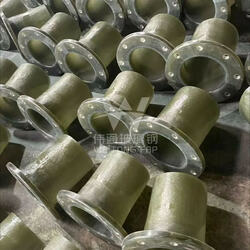
FRP ducts are ventilation pipes made with a resin or magnesium oxychloride cement matrix and glass fiber as reinforcement. They are categorized into two main types: organic FRP ducts resin-based and inorganic FRP ducts magnesium oxychloride cement-based. Our company primarily produces and sells organic FRP ducts with a resin matrix.
Fiberglass Duct Manufacturing
Filing Process: Resin-impregnated fiberglass is wound layer by layer around a rotating mandrel, with a sand layer for enhanced rigidity.
Hand Lay-up Process: Fiberglass cloth is applied to the mold surface and then coated with resin. Multiple layers are stacked, then cured and released. Suitable for special-shaped pipe fittings.
Core Features and Advantages
Lightweight and High Strength
Weighing only 1/10 of concrete pipes and 30% of steel pipes of the same specification, they are easy to transport and install.
Compressive strength reaches 65 MPa organic type, with excellent impact resistance.
Corrosion Resistance and Durability
Organic type: Resistant to acid, alkali, and salt corrosion, suitable for corrosive gas emissions in the chemical, textile, and other industries.
Environmental Adaptability
Wide operating temperature range -40°C to 80°C, resistant to humidity, heat, and freeze-thaw.
Excellent fluid performance
Smooth inner wall, low resistance, 10% higher flow rate than steel pipes of the same specification, reducing energy consumption. No residual fluid scale, stable flow rate over long-term use.
Economical
Low overall cost, maintenance-free, no anti-corrosion treatment required. The larger the pipe diameter, the greater the cost advantage.
Application Areas
Fiberglass Duct: Exhaust for corrosive environments such as chemical plants, electroplating plants, and laboratories. Installation Specifications
Connection Method: Socket-jointed inorganic models or flange bolts organic models, sealed with 8501 rubber strips.
Reinforcement Requirements: Ribs are required for side lengths 1000 mm, with longitudinal spacing ? 1250 mm.
Support and Hanger Spacing: ? 2 m for horizontal installation with a side length ? 2000 mm, with a hanger diameter ? 10 mm.
Quality Control
Wall Thickness Tolerance: -1 to 0 mm for side lengths ? 300 mm.
Air Leakage Test: Light leakage testing is required, ensuring zero light leakage at the interface.
Defect Prevention for Inorganic Models: Control slurry uniformity, curing temperature and humidity, and avoid flange deformation.