Ningbo EBO Optoelectronics Technology CO., LTD
BGO Scintillation Crystal Bismuth Germanate
Price:
USD 1.00 - 1000.00
Product Description
BGO Bismuth Germanate is a high-Z, high-density scintillating crystal. The material has a high atomic number Z83 for bismuth and a density of 7.13 g/cm³, making it a highly efficient gamma-ray absorber.
Due to the high-Z properties of the material, the gamma-ray-induced light absorption fraction is significantly enhanced, resulting in an excellent peak-to-total ratio.
Specification Parameter
Properties Value Unit
Density 7.13 g/cm³
Melting point 1323 K
Effective atomic number 74
Hardness 5 Mohs
Refractive index 2.15
Decay Constant 317 ns
Radiation length 1.1 cm
Wavelength of emission max 480 nm
Light yield 8500 Photon/Mev
Hygroscopic No
BGO Bismuth Germanate, Bi?Ge?O?? is a high-density, high-Z inorganic scintillator crystal renowned for its excellent gamma-ray stopping power, good energy resolution, and strong radiation resistance. The BGO crystal is widely used in applications such as positron emission tomography PET, high-energy physics experiments, and industrial gamma-ray detection.
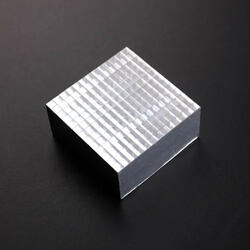
EBO offers flexible customization of BGO crystals in terms of size, shape, and geometry to meet specific customer requirements. In addition to single crystals, EBO also provides tailored scintillator array configurations for various applications. EBO's manufacturing capabilities support array pixel sizes as small as 0.2 × 0.2 mm, enabling high-resolution imaging.
Common internal reflective materials include BaSO?, ESR, and E20 reflective film. These can be selected or recommended based on the application environment to optimize light collection efficiency and overall system performance.
Advantage of BGO Crystal
Unique BaSO4 reflector coating
High precision matching
Quality control of each crystal
Application of BGO Crystal
Low-cost PET
Small animal PET
Organ-specific PET
Particle detection
Radiation detection
Typical Sizes and Configurations of BGO Crystal
Available in large sizes and variable shapes
Typical detector sizes range from 1 to 5 and can be up to 5 thick
Other shapes; cube, hexagon
pixels as small as 0.5 mm2 or for arrays as small as 0.3 mm